
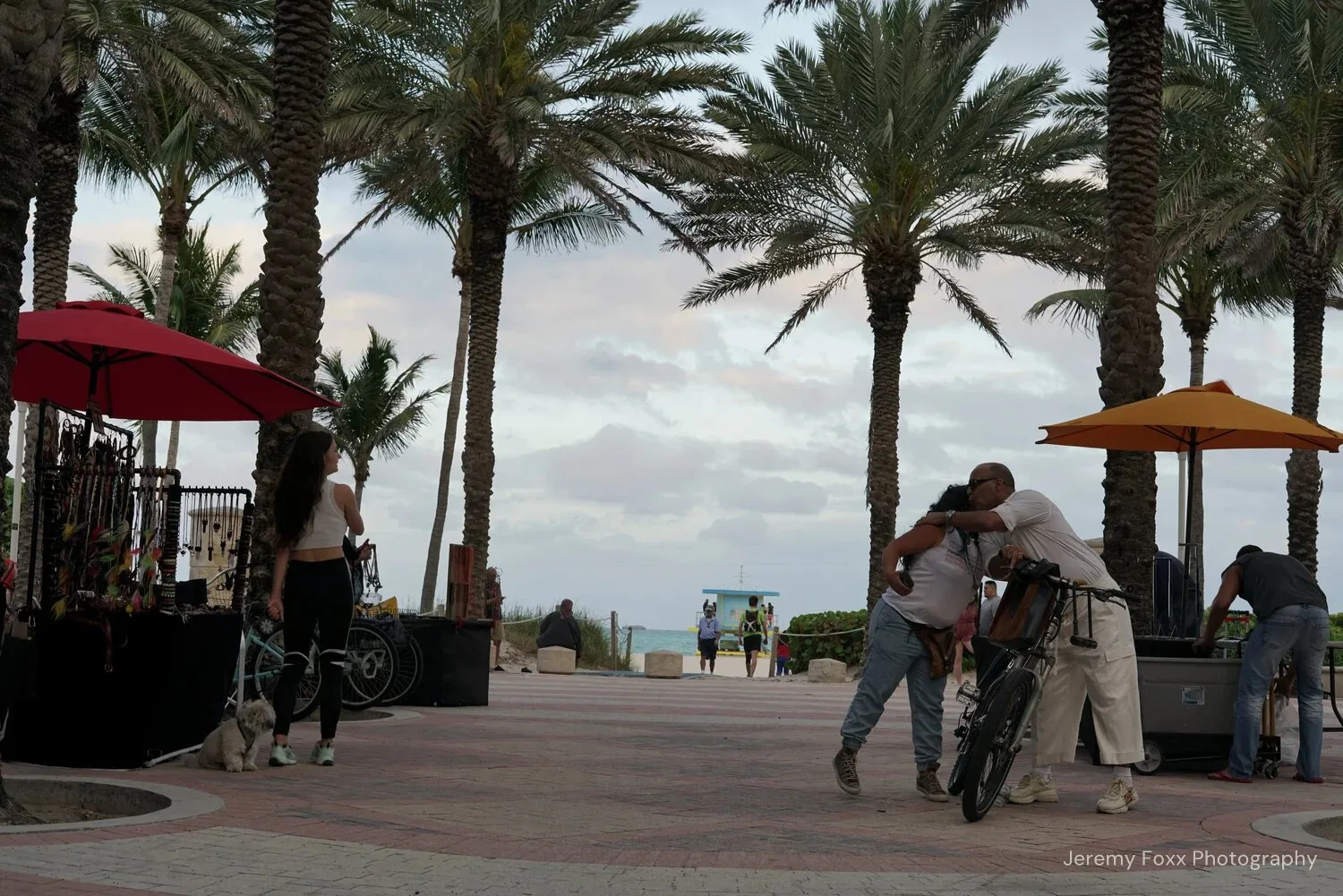
Two people embrace beside a bicycle under the palms. A small white dog sits across the path, and the ocean is visible between them.
A closer look
The hug by the bicycle would make a picture all on its own. Then there’s that little white dog across the path, sitting under the red umbrella with an excellent view. I’d keep the whole frame. There’s even a bit of ocean between them.
I had the 50 mm at f/7.1, which gives more room in focus for the people, the bicycle and that dog across the path. The 1/50 s exposure suits the little pause in the hug. A bicycle going past would tell quite a different story at that speed.
Try it yourself
Try covering the left half of this picture with your hand. You still get the embrace, but the dog and the walk down to the beach are gone. Next time you’re framing a street picture, have a quick look at the far edge before you zoom in. There might be a second little story over there.
Camera settings
- Camera
- Sony α7R II (ILCE-7RM2)
- Lens
- FE 50mm F1.8
- Focal length
- 50 mm
- Aperture
- f/7.1
- Shutter speed
- 1/50 s
- ISO
- 100
Capture settings from the matching photograph in Jeremy’s Lightroom catalog.
What do these settings mean?
- Camera · Sony α7R II (ILCE-7RM2)
- This is the camera body that recorded the picture. Inside it is the sensor that collects the light coming through the lens.
- Lens · FE 50mm F1.8
- This is a prime lens. Its 50 mm view is fixed. To get more of a building in the frame, you need more room to step back.
- Focal length · 50 mm
- This is the lens setting in millimeters. From the same spot on the same camera, fewer millimeters fit more of the scene into the frame. More millimeters make a distant subject fill more of the picture.
- Aperture · f/7.1
- Think of the opening in the lens. At f/4 it’s wider than at f/8, so more light comes through. At the same focus distance and focal length, a wider opening also makes it easier to blur what’s behind your subject.
- Shutter speed · 1/50 s
- This is how long the sensor gathers light, measured in seconds. With a fraction, the bigger the number on the bottom, the shorter the exposure. Give a moving subject more time and a sharp edge can turn into a streak.
- ISO · 100
- ISO sets how brightly the camera renders the light it collected. If the picture is too dark and a slower shutter would blur the shot, raising ISO can help. In low light you may also see grain in the shadows.