
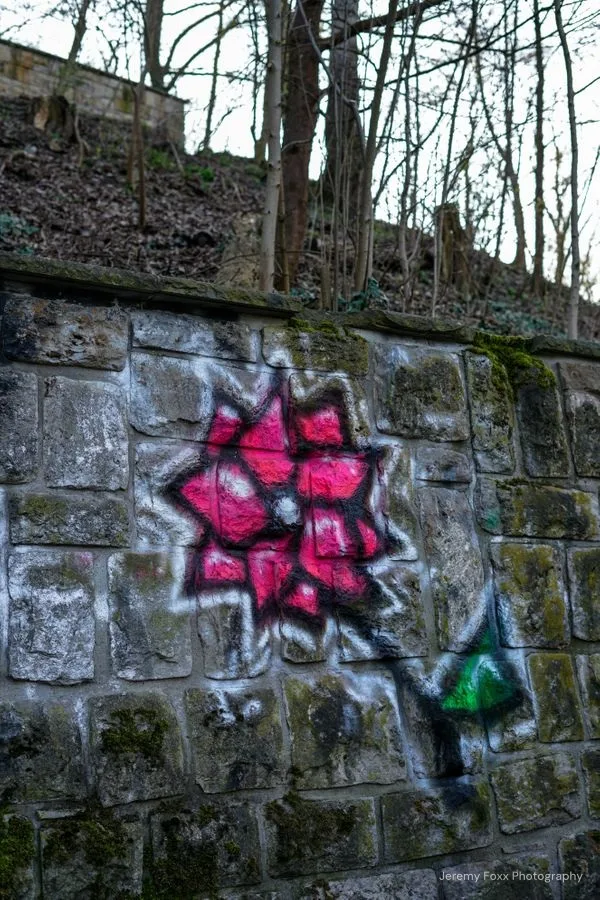
Bright pink graffiti on a gray stone wall beneath leafless trees.
A closer look
Spring came to this gray wall with a can of pink paint. You can still follow the mortar joints through the flower. That small detail is what gives a two-dimensional blossom a very particular place in Berlin.
At 50 mm the painted flower takes up a good piece of gray wall, with room above it for the bare trees. The f/4 opening keeps the joints and paint on that one flat surface readable together. A real flower would have rather more depths to contend with.
Try it yourself
Look for painted work viewed legally from the street and frame it with a little of its surroundings. Stand square to the blocks, then shift upward or down until a tree trunk avoids the brightest part of the paint.
Camera settings
- Camera
- Sony α7R II (ILCE-7RM2)
- Lens
- FE 50mm F1.8
- Focal length
- 50 mm
- Aperture
- f/4
- Shutter speed
- 1/100 s
- ISO
- 100
Capture settings from the matching photograph in Jeremy’s Lightroom catalog.
What do these settings mean?
- Camera · Sony α7R II (ILCE-7RM2)
- This is the camera body that recorded the picture. Inside it is the sensor that collects the light coming through the lens.
- Lens · FE 50mm F1.8
- This is a prime lens. Its 50 mm view is fixed. To get more of a building in the frame, you need more room to step back.
- Focal length · 50 mm
- This is the lens setting in millimeters. From the same spot on the same camera, fewer millimeters fit more of the scene into the frame. More millimeters make a distant subject fill more of the picture.
- Aperture · f/4
- Think of the opening in the lens. At f/4 it’s wider than at f/8, so more light comes through. At the same focus distance and focal length, a wider opening also makes it easier to blur what’s behind your subject.
- Shutter speed · 1/100 s
- This is how long the sensor gathers light, measured in seconds. With a fraction, the bigger the number on the bottom, the shorter the exposure. Give a moving subject more time and a sharp edge can turn into a streak.
- ISO · 100
- ISO sets how brightly the camera renders the light it collected. If the picture is too dark and a slower shutter would blur the shot, raising ISO can help. In low light you may also see grain in the shadows.