
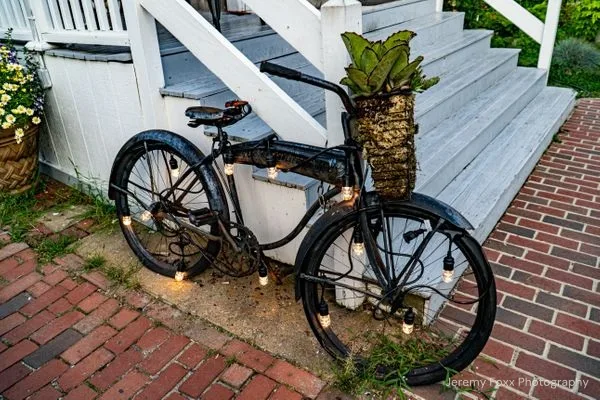
A bicycle leans beside a brick path and the white shingles of a house.
A closer look
Somebody parked a bicycle against a palm by the white steps. Those dark wheels stand out so well against the siding that you can follow each one right down to the brick. A parked bicycle has the good manners to give you time to find that angle.
At 18 mm, even this near the bicycle, both wheels and the front steps fit. The lens was open to f/4. Since the bicycle and the siding behind it are fairly close together, the white boards still show through the spokes.
Try it yourself
Stand where a bicycle's wheels separate in profile with a simple wall behind them. Leave room around the tires and check where the handlebar meets any rail or post before deciding whether to move a step.
Camera settings
- Camera
- Sony α7R II (ILCE-7RM2)
- Lens
- E PZ 18-105mm F4 G OSS
- Focal length
- 18 mm
- Aperture
- f/4
- Shutter speed
- 1/800 s
- ISO
- 500
Capture settings from the matching photograph in Jeremy’s Lightroom catalog.
What do these settings mean?
- Camera · Sony α7R II (ILCE-7RM2)
- This is the camera body that recorded the picture. Inside it is the sensor that collects the light coming through the lens.
- Lens · E PZ 18-105mm F4 G OSS
- The lens focuses light onto the sensor. On a zoom lens, two numbers in millimeters tell you its widest and tightest views.
- Focal length · 18 mm
- This is the lens setting in millimeters. From the same spot on the same camera, fewer millimeters fit more of the scene into the frame. More millimeters make a distant subject fill more of the picture.
- Aperture · f/4
- Think of the opening in the lens. At f/4 it’s wider than at f/8, so more light comes through. At the same focus distance and focal length, a wider opening also makes it easier to blur what’s behind your subject.
- Shutter speed · 1/800 s
- This is how long the sensor gathers light, measured in seconds. With a fraction, the bigger the number on the bottom, the shorter the exposure. Give a moving subject more time and a sharp edge can turn into a streak.
- ISO · 500
- ISO sets how brightly the camera renders the light it collected. If the picture is too dark and a slower shutter would blur the shot, raising ISO can help. In low light you may also see grain in the shadows.