
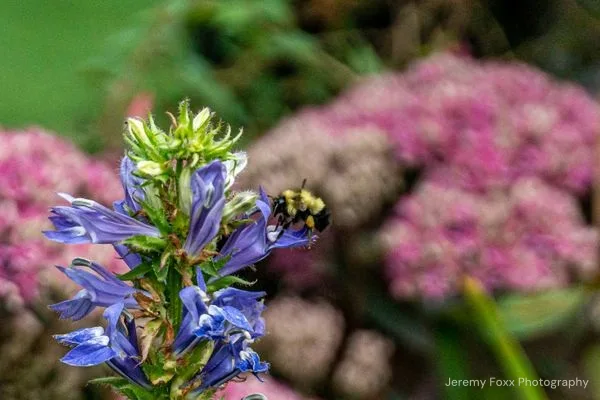
A bumblebee on a violet flower spike against a pink and green garden.
A closer look
There’s a yellow band on the bee that reads beautifully against the pink in the distance. Try covering that soft patch and see how much harder it is to pick out the visitor. The garden behind a bee can do quite a bit of work.
The shutter time was 1/8000 of a second. Look at the outline of the bee as it leans out from the spike. The 76 mm view makes it large enough to see that yellow band while leaving the broad pink flower heads behind it.
Try it yourself
Find a bloom visited by bees and choose a background several feet beyond it. Keep your distance and wait for a brief side-on pause, then check that the bee's head and the edge of the flower both read clearly.
Camera settings
- Camera
- Sony α7R II (ILCE-7RM2)
- Lens
- E PZ 18-105mm F4 G OSS
- Focal length
- 76 mm
- Aperture
- f/4
- Shutter speed
- 1/8000 s
- ISO
- 500
Capture settings from the matching photograph in Jeremy’s Lightroom catalog.
What do these settings mean?
- Camera · Sony α7R II (ILCE-7RM2)
- This is the camera body that recorded the picture. Inside it is the sensor that collects the light coming through the lens.
- Lens · E PZ 18-105mm F4 G OSS
- The lens focuses light onto the sensor. On a zoom lens, two numbers in millimeters tell you its widest and tightest views.
- Focal length · 76 mm
- This is the lens setting in millimeters. From the same spot on the same camera, fewer millimeters fit more of the scene into the frame. More millimeters make a distant subject fill more of the picture.
- Aperture · f/4
- Think of the opening in the lens. At f/4 it’s wider than at f/8, so more light comes through. At the same focus distance and focal length, a wider opening also makes it easier to blur what’s behind your subject.
- Shutter speed · 1/8000 s
- This is how long the sensor gathers light, measured in seconds. With a fraction, the bigger the number on the bottom, the shorter the exposure. Give a moving subject more time and a sharp edge can turn into a streak.
- ISO · 500
- ISO sets how brightly the camera renders the light it collected. If the picture is too dark and a slower shutter would blur the shot, raising ISO can help. In low light you may also see grain in the shadows.