
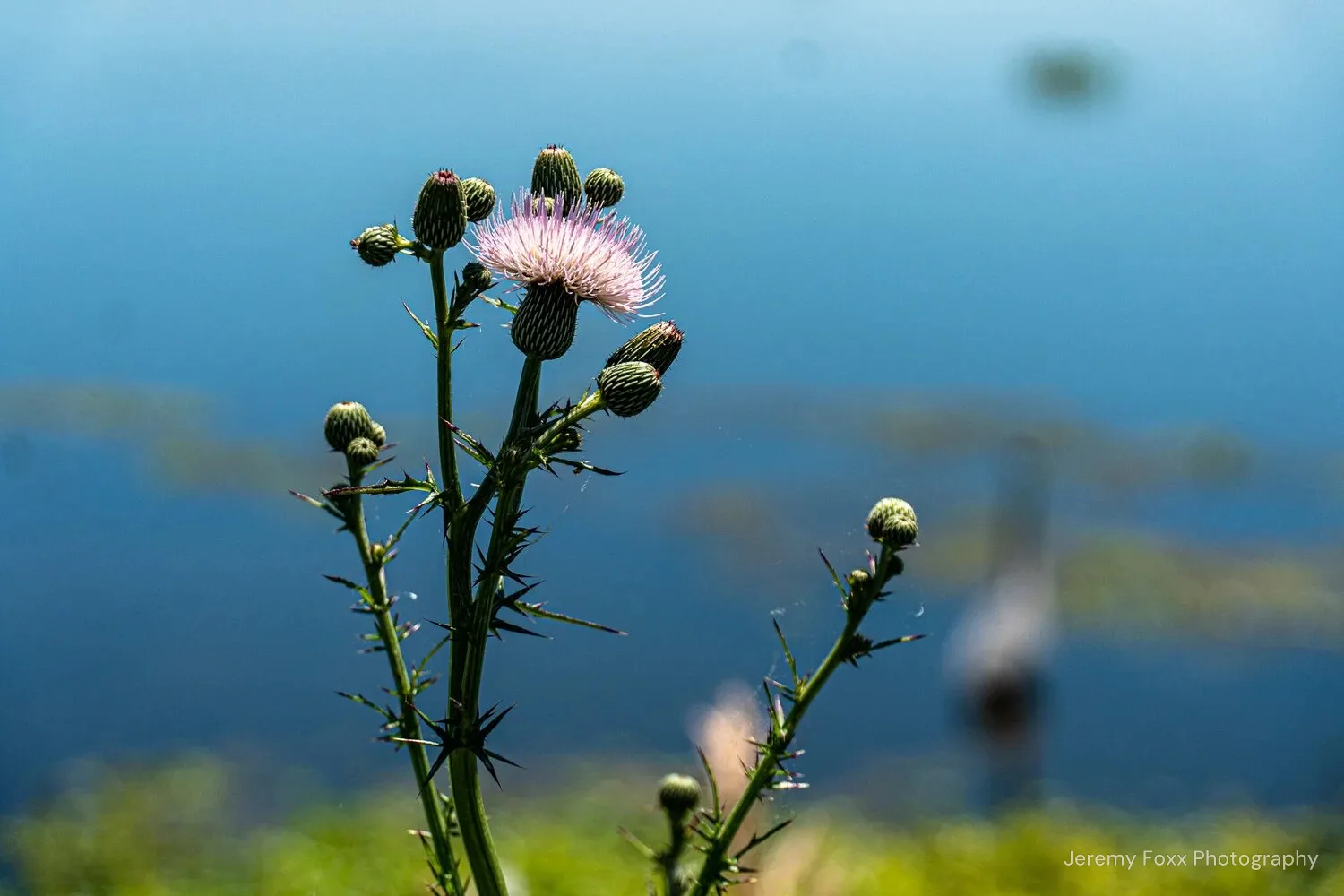
A pink wildflower rises against a soft blue water background.
A closer look
That pink flower found itself a very handsome blue backdrop. You’d hardly guess all that blue was water. At f/4 the ripples soften enough to leave the petals with the sharpest edges in the picture.
See how the water behind the flower turns into a wash of blue? The flower is close and the water is farther off. Opening this lens to f/4 helps soften that background, even though the flower itself stays in focus.
Try it yourself
Move until the flower sits against a clear patch of water. Focus on the nearest important petal and change your position slightly before changing aperture to simplify the background.
Camera settings
- Camera
- Sony α7R II (ILCE-7RM2)
- Lens
- E PZ 18-105mm F4 G OSS
- Focal length
- 65 mm
- Aperture
- f/4
- Shutter speed
- 1/3200 s
- ISO
- 100
Capture settings from the matching photograph in Jeremy’s Lightroom catalog.
What do these settings mean?
- Camera · Sony α7R II (ILCE-7RM2)
- This is the camera body that recorded the picture. Inside it is the sensor that collects the light coming through the lens.
- Lens · E PZ 18-105mm F4 G OSS
- The lens focuses light onto the sensor. On a zoom lens, two numbers in millimeters tell you its widest and tightest views.
- Focal length · 65 mm
- This is the lens setting in millimeters. From the same spot on the same camera, fewer millimeters fit more of the scene into the frame. More millimeters make a distant subject fill more of the picture.
- Aperture · f/4
- Think of the opening in the lens. At f/4 it’s wider than at f/8, so more light comes through. At the same focus distance and focal length, a wider opening also makes it easier to blur what’s behind your subject.
- Shutter speed · 1/3200 s
- This is how long the sensor gathers light, measured in seconds. With a fraction, the bigger the number on the bottom, the shorter the exposure. Give a moving subject more time and a sharp edge can turn into a streak.
- ISO · 100
- ISO sets how brightly the camera renders the light it collected. If the picture is too dark and a slower shutter would blur the shot, raising ISO can help. In low light you may also see grain in the shadows.