
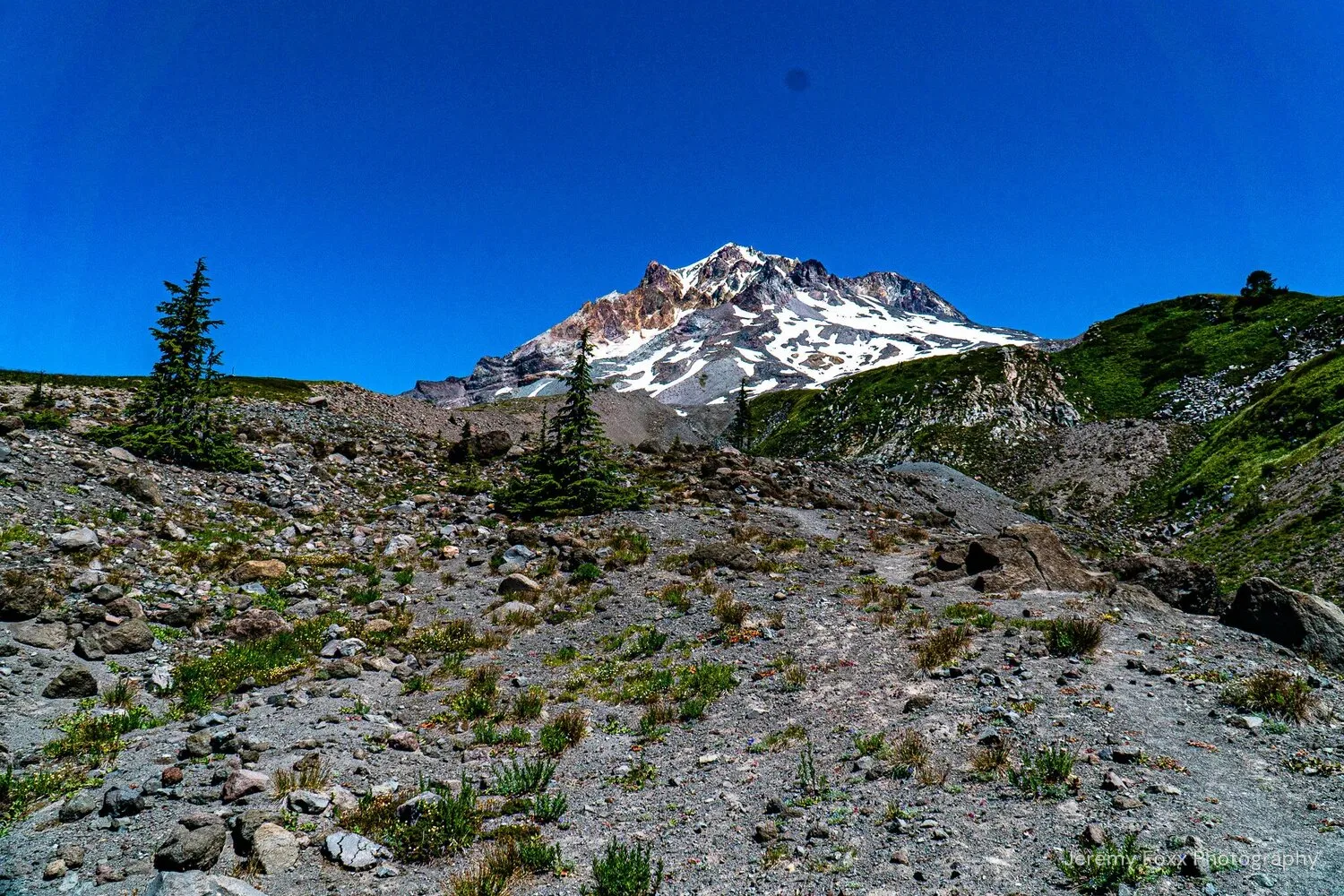
A snow-streaked summit rises above a rocky slope and green shrubs.
A closer look
Start with the shrubs down low and work your way up through the bare rock to the snow. There’s a little of the climb in each part of this frame. Fortunately you can do this version sitting down.
At f/8 the shutter still reached 1/3200 s at ISO 100. There’s a lot of light on that snowy summit. Look at the streaks of rock showing through it and you’ll see why it’s worth keeping an eye on the brightest part.
Try it yourself
Move until the nearest shrub clears the most distinctive part of the ridgeline. Make a wide view for the whole slope and a tighter one to compare the pattern of snow.
Camera settings
- Camera
- Sony α7R II (ILCE-7RM2)
- Lens
- E PZ 18-105mm F4 G OSS
- Focal length
- 18 mm
- Aperture
- f/8
- Shutter speed
- 1/3200 s
- ISO
- 100
Capture settings from the matching photograph in Jeremy’s Lightroom catalog.
What do these settings mean?
- Camera · Sony α7R II (ILCE-7RM2)
- This is the camera body that recorded the picture. Inside it is the sensor that collects the light coming through the lens.
- Lens · E PZ 18-105mm F4 G OSS
- The lens focuses light onto the sensor. On a zoom lens, two numbers in millimeters tell you its widest and tightest views.
- Focal length · 18 mm
- This is the lens setting in millimeters. From the same spot on the same camera, fewer millimeters fit more of the scene into the frame. More millimeters make a distant subject fill more of the picture.
- Aperture · f/8
- Think of the opening in the lens. At f/4 it’s wider than at f/8, so more light comes through. At the same focus distance and focal length, a wider opening also makes it easier to blur what’s behind your subject.
- Shutter speed · 1/3200 s
- This is how long the sensor gathers light, measured in seconds. With a fraction, the bigger the number on the bottom, the shorter the exposure. Give a moving subject more time and a sharp edge can turn into a streak.
- ISO · 100
- ISO sets how brightly the camera renders the light it collected. If the picture is too dark and a slower shutter would blur the shot, raising ISO can help. In low light you may also see grain in the shadows.