
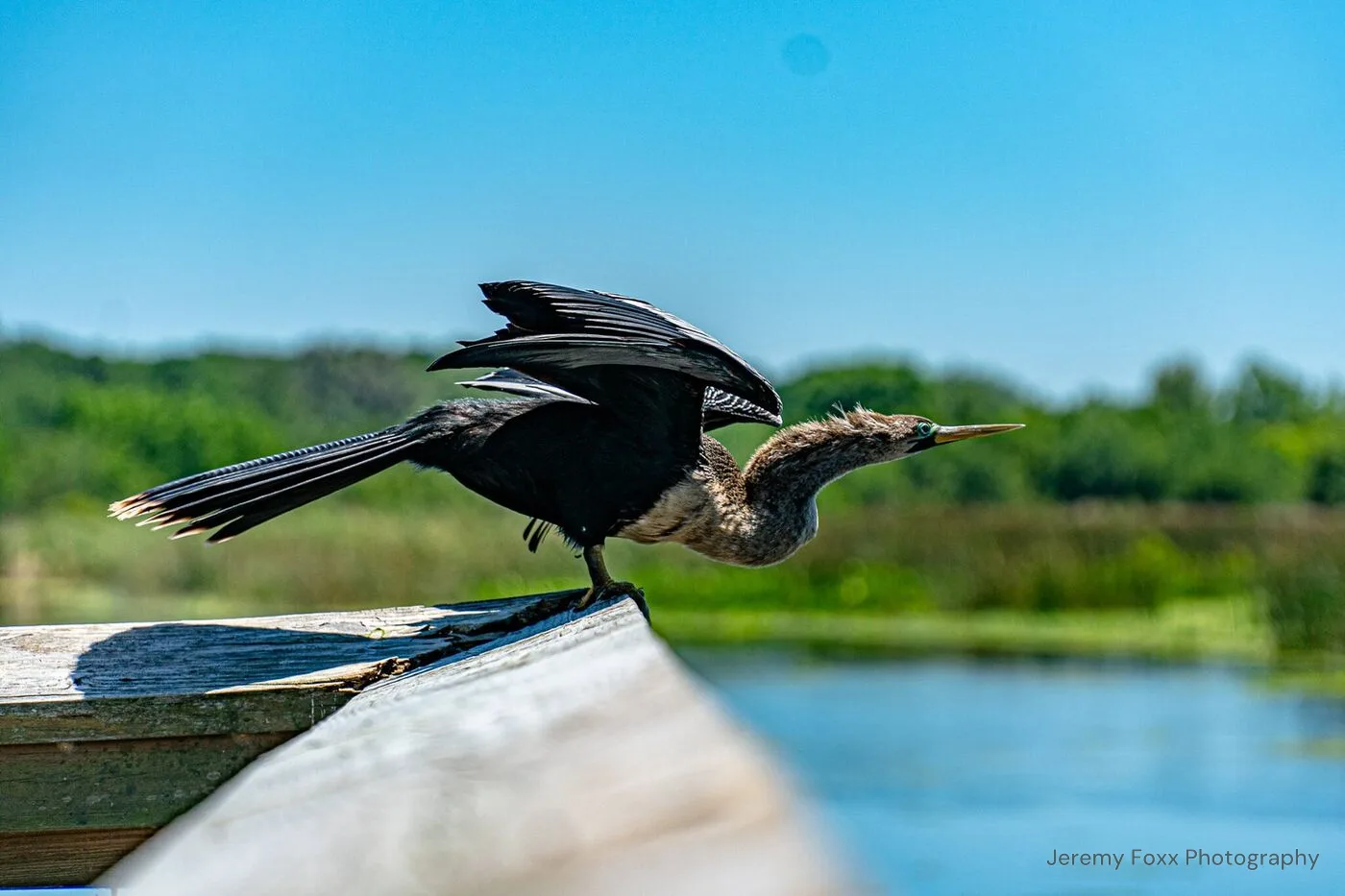
A waterbird grips the edge of a wooden rail, wings half open and neck stretched over the water.
A closer look
Everything about this bird says departure, right down to those last few toes saying otherwise. At 105 mm and 1/1600 of a second you can see them curled around the wood. Put your thumb over the rail and watch the bird take off.
The shutter was open for 1/1600 of a second. That’s short enough to catch the toes still on the rail with the wings already up. The zoom was at its longest setting, 105 mm. At f/4 the far bank goes soft enough that you can pick out the thin tip of the bill against it.
Try it yourself
When a bird settles on a perch, you’ve got a chance to frame the picture before anything happens. From where you’re already standing, focus on its eye and leave room in front of its bill. If it takes off, look through the pictures for the last one where a foot still touches the perch.
Camera settings
- Camera
- Sony α7R II (ILCE-7RM2)
- Lens
- E PZ 18-105mm F4 G OSS
- Focal length
- 105 mm
- Aperture
- f/4
- Shutter speed
- 1/1600 s
- ISO
- 100
Capture settings from the matching photograph in Jeremy’s Lightroom catalog.
What do these settings mean?
- Camera · Sony α7R II (ILCE-7RM2)
- This is the camera body that recorded the picture. Inside it is the sensor that collects the light coming through the lens.
- Lens · E PZ 18-105mm F4 G OSS
- The lens focuses light onto the sensor. On a zoom lens, two numbers in millimeters tell you its widest and tightest views.
- Focal length · 105 mm
- This is the lens setting in millimeters. From the same spot on the same camera, fewer millimeters fit more of the scene into the frame. More millimeters make a distant subject fill more of the picture.
- Aperture · f/4
- Think of the opening in the lens. At f/4 it’s wider than at f/8, so more light comes through. At the same focus distance and focal length, a wider opening also makes it easier to blur what’s behind your subject.
- Shutter speed · 1/1600 s
- This is how long the sensor gathers light, measured in seconds. With a fraction, the bigger the number on the bottom, the shorter the exposure. Give a moving subject more time and a sharp edge can turn into a streak.
- ISO · 100
- ISO sets how brightly the camera renders the light it collected. If the picture is too dark and a slower shutter would blur the shot, raising ISO can help. In low light you may also see grain in the shadows.