
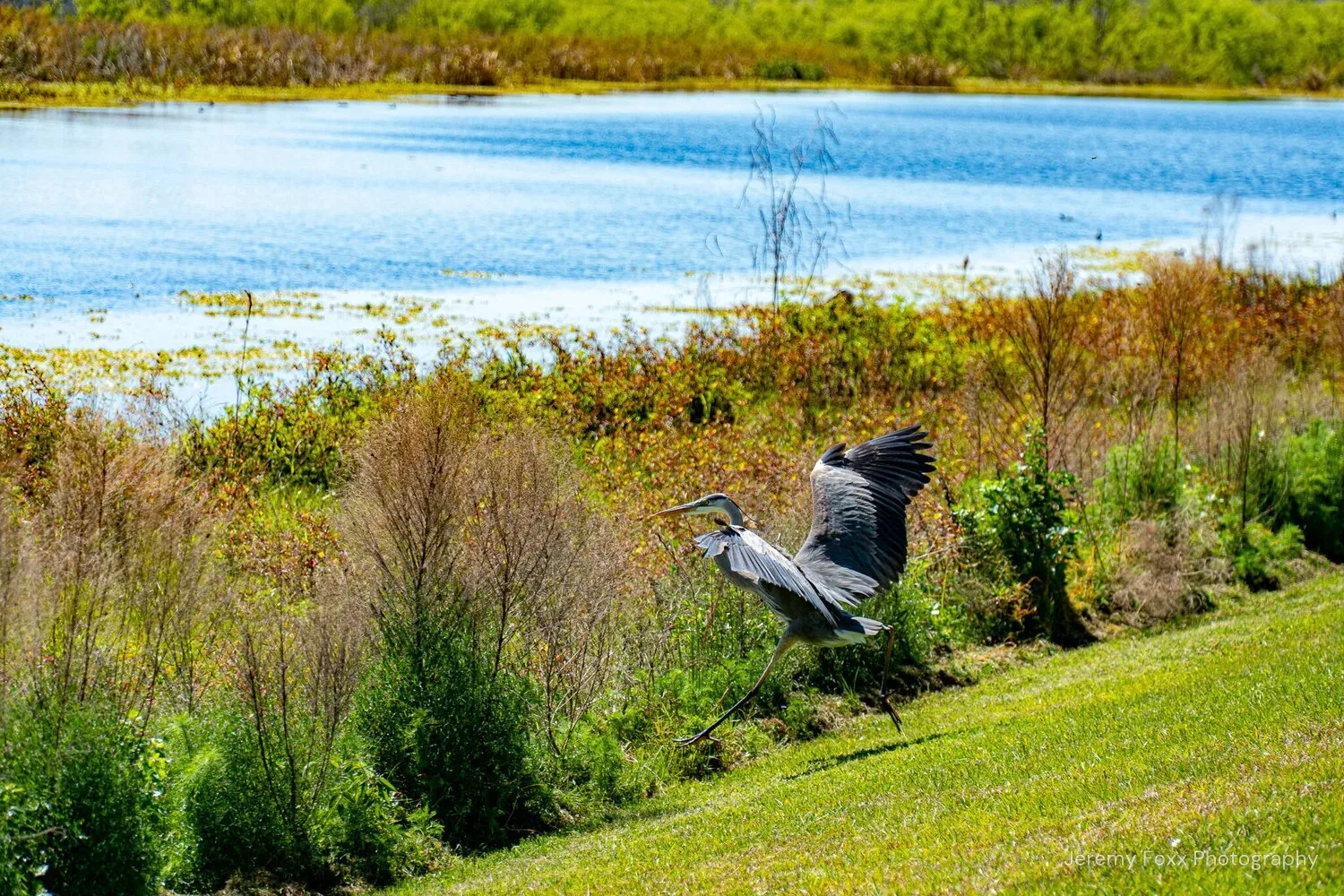
A long-legged gray bird takes flight beside reeds and blue water.
A closer look
Watch where the legs come clear of the reeds. Against the blue water you can suddenly count the long bits that fold up under a bird. The shutter was open for 1/1000 of a second.
Look at the long legs trailing behind the bird. That’s where a little motion blur would show up. The shutter stayed open for just 1/1000 of a second, so the feet had very little time to travel across the picture.
Try it yourself
Watch a landing or feeding area from an established path. Leave room for the first wingbeat, track through the movement and check the feet as well as the head before choosing a frame.
Camera settings
- Camera
- Sony α7R II (ILCE-7RM2)
- Lens
- E PZ 18-105mm F4 G OSS
- Focal length
- 103 mm
- Aperture
- f/4
- Shutter speed
- 1/1000 s
- ISO
- 100
Capture settings from the matching photograph in Jeremy’s Lightroom catalog.
What do these settings mean?
- Camera · Sony α7R II (ILCE-7RM2)
- This is the camera body that recorded the picture. Inside it is the sensor that collects the light coming through the lens.
- Lens · E PZ 18-105mm F4 G OSS
- The lens focuses light onto the sensor. On a zoom lens, two numbers in millimeters tell you its widest and tightest views.
- Focal length · 103 mm
- This is the lens setting in millimeters. From the same spot on the same camera, fewer millimeters fit more of the scene into the frame. More millimeters make a distant subject fill more of the picture.
- Aperture · f/4
- Think of the opening in the lens. At f/4 it’s wider than at f/8, so more light comes through. At the same focus distance and focal length, a wider opening also makes it easier to blur what’s behind your subject.
- Shutter speed · 1/1000 s
- This is how long the sensor gathers light, measured in seconds. With a fraction, the bigger the number on the bottom, the shorter the exposure. Give a moving subject more time and a sharp edge can turn into a streak.
- ISO · 100
- ISO sets how brightly the camera renders the light it collected. If the picture is too dark and a slower shutter would blur the shot, raising ISO can help. In low light you may also see grain in the shadows.