
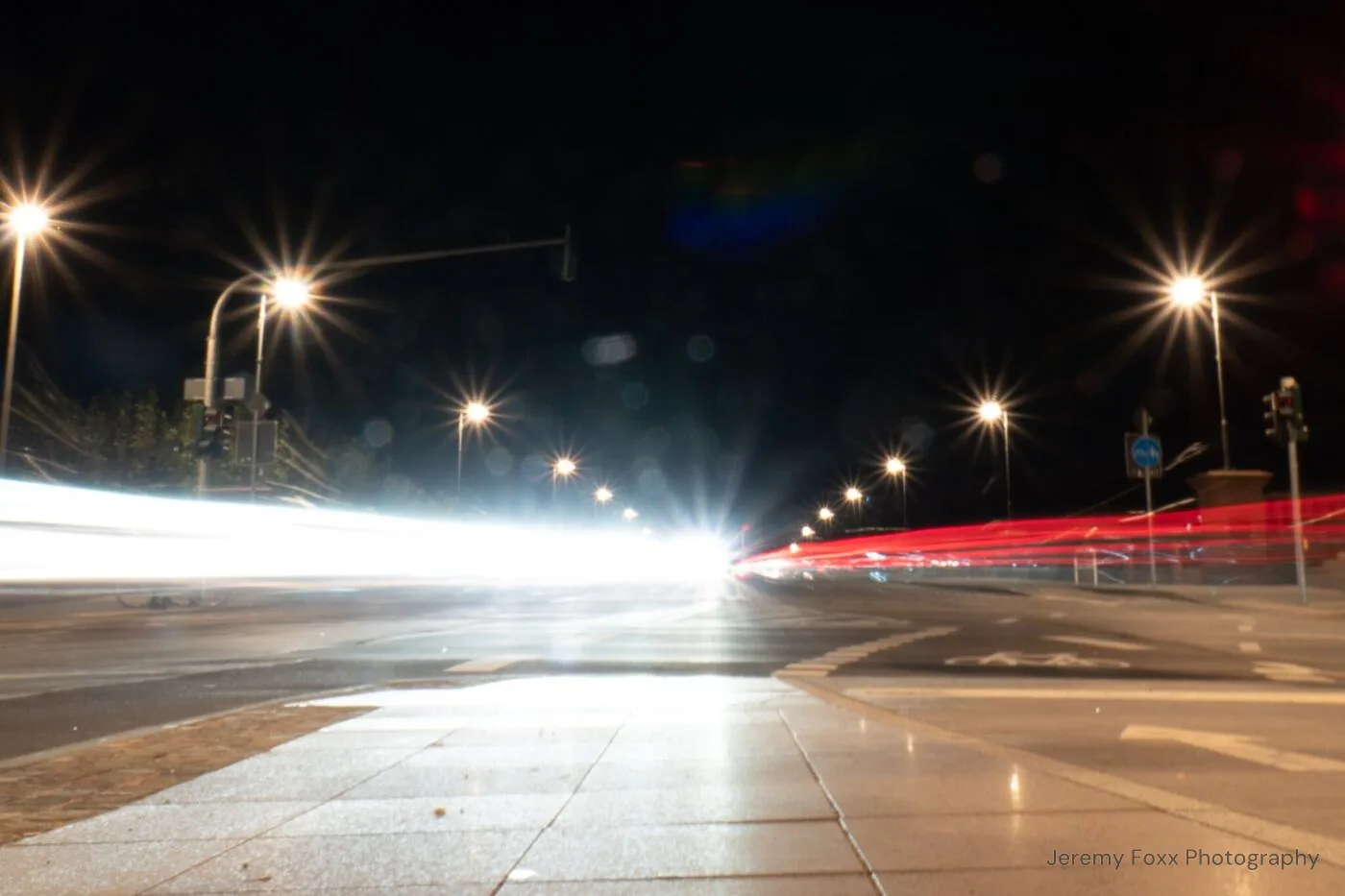
White and red light trails meet at a brightly lit intersection at night.
A closer look
White coming through the junction, red trailing away. The bright paving in the foreground gives those lines a place on an actual street. Cover it with your hand and see how quickly the whole thing turns abstract.
Twenty seconds at f/22 gives more than one vehicle a chance to leave its mark. With ISO 100 recorded, the yellow-white patch where several lights overlap is a good place to check for lost detail.
Try it yourself
Find a safe stationary viewpoint that includes both directions of traffic. Time one exposure for the approaching lights and a second for the departing lights, then compare where they overlap.
Camera settings
- Camera
- Sony α7R II (ILCE-7RM2)
- Lens
- E PZ 18-105mm F4 G OSS
- Focal length
- 18 mm
- Aperture
- f/22
- Shutter speed
- 20 s
- ISO
- 100
Capture settings from the matching photograph in Jeremy’s Lightroom catalog.
What do these settings mean?
- Camera · Sony α7R II (ILCE-7RM2)
- This is the camera body that recorded the picture. Inside it is the sensor that collects the light coming through the lens.
- Lens · E PZ 18-105mm F4 G OSS
- The lens focuses light onto the sensor. On a zoom lens, two numbers in millimeters tell you its widest and tightest views.
- Focal length · 18 mm
- This is the lens setting in millimeters. From the same spot on the same camera, fewer millimeters fit more of the scene into the frame. More millimeters make a distant subject fill more of the picture.
- Aperture · f/22
- Think of the opening in the lens. At f/4 it’s wider than at f/8, so more light comes through. At the same focus distance and focal length, a wider opening also makes it easier to blur what’s behind your subject.
- Shutter speed · 20 s
- This is how long the sensor gathers light, measured in seconds. With a fraction, the bigger the number on the bottom, the shorter the exposure. Give a moving subject more time and a sharp edge can turn into a streak.
- ISO · 100
- ISO sets how brightly the camera renders the light it collected. If the picture is too dark and a slower shutter would blur the shot, raising ISO can help. In low light you may also see grain in the shadows.